Occupy Sydney Protesters Moved On From Hyde Park

SYDNEY, AUSTRALIA – Following the Occupy Sydney street march on Guy Fawkes Day (November 5), the movement’s members gathered in Hyde Park in downtown Sydney.

NSW Police line up in Hyde Park.

A member of Occupy Sydney in Hyde Park.

NSW Police obtaining video footage of Occupy Sydney protesters.

NSW Police line up in Hyde Park.

Protesters and police in Hyde Park.

A member of Occupy Sydney talking to police.
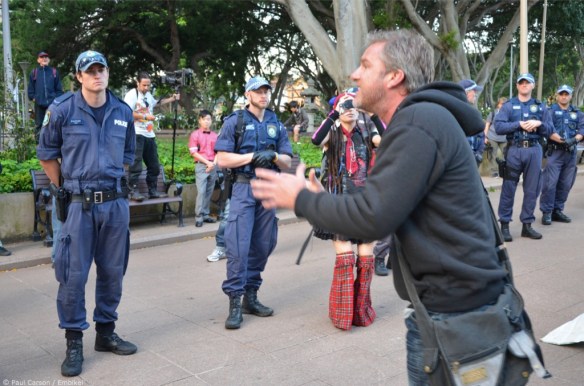
Protesters and police in Hyde Park.

Protesters and police in Hyde Park.

Live blogging from the Occupy Sydney gathering in Hyde Park.
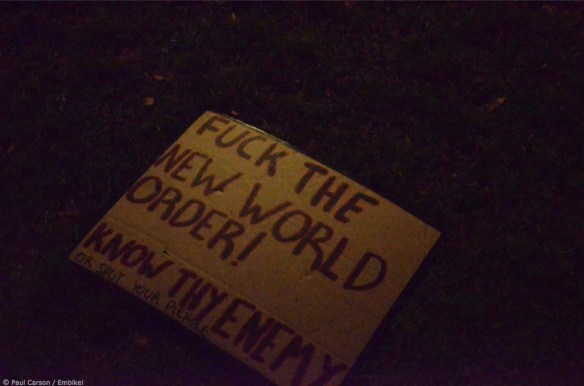
An Occupy Sydney placard.
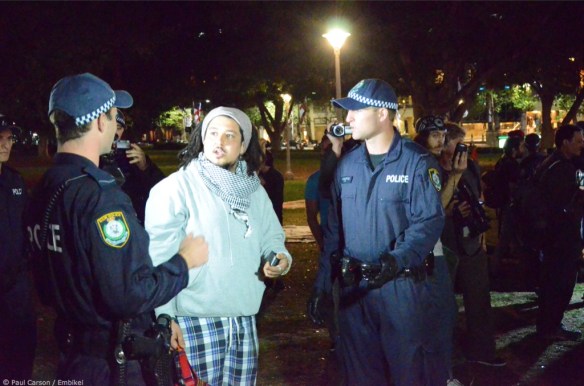
A protester arrested and charged for swearing during the Occupy Sydney gathering in Hyde Park.
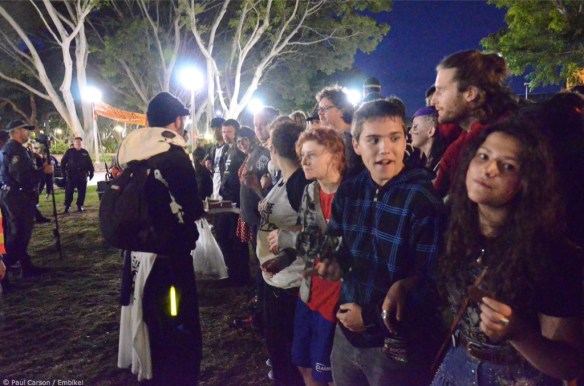
Occupy Sydney protesters linking up in Hyde Park.

Police with a protester.

Occupy Sydney protesters linking up in Hyde Park.
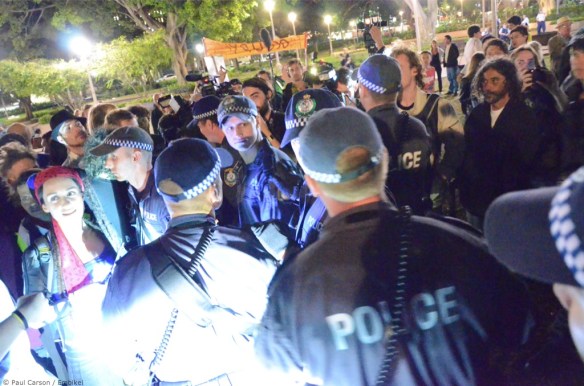
Occupy Sydney protesters and police.

Meditating protesters at Hyde Park.

Riot Squad police line up at Hyde park.
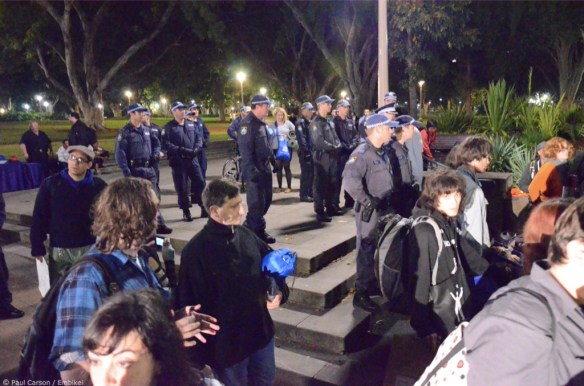
Police dispersing the crowd from Hyde Park.
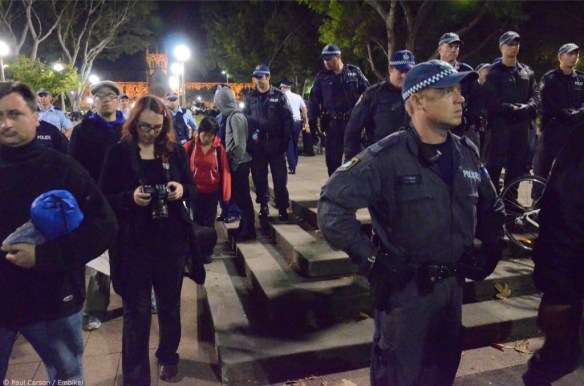
Police dispersing the crowd from Hyde Park.
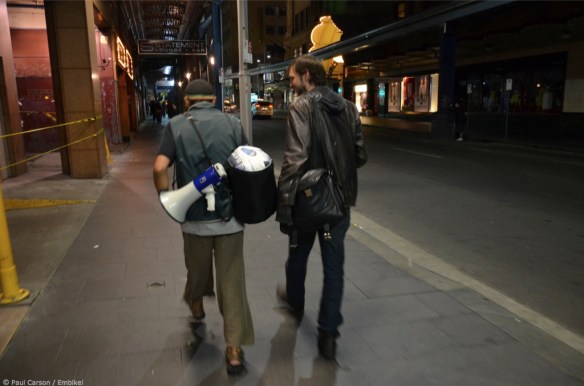
Heading home.

New South Wales Police maintained a strong presence throughout the day, and just before 2:00 on Sunday morning (November 6), the protesters were instructed to move on or face the possibility of arrest.

The protesters held out until the last minute before leaving the park. Members of the NSW Police Force followed the group for several blocks to ensure that they dispersed.

The rally was mostly peaceful, but tense. Six protesters were arrested for various offences during the day.

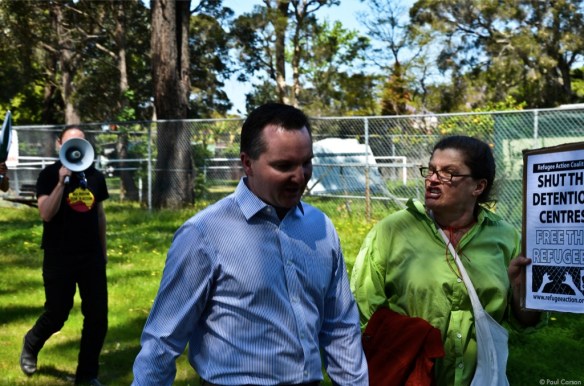
Australian Immigration Minister Accosted by Pro-refugee Protesters

SYDNEY, AUSTRALIA – Australian Federal Immigration and Citizenship Minister Chris Bowen was accosted by pro-refugee activists today while giving a press conference in Smithfield.

Federal Immigration Minister Chris Bowen with members of the press.

A pro-refugee activist makes her feelings known to Minister Bowen.

Federal Immigration Minister Chris Bowen

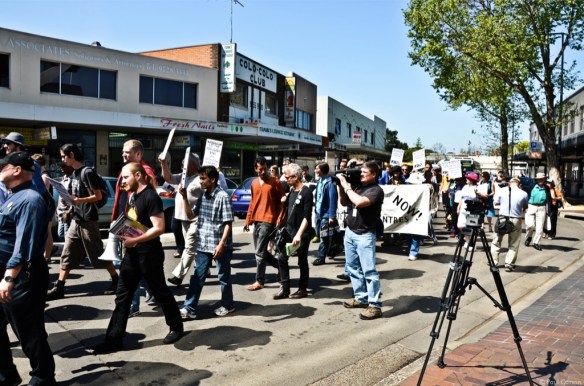
Pro-refugee activists marching through Fairfield.

Pro-refugee activists marching through Fairfield.

Pro-refugee activists marching through Fairfield.

A bystander watches as pro-refugee activists march through the streets of Fairfield.

Pro-refugee activists marching through Fairfield.

Pro-refugee activists gathering outside the electoral office of Federal Immigration Minister Chris Bowen.

The protesters had gathered outside his electoral office in nearby Fairfield when word got out that the minister was speaking to the press a short distance away.

More details and images at my Demotix site.

Pro-Refugee Rally in Sydney

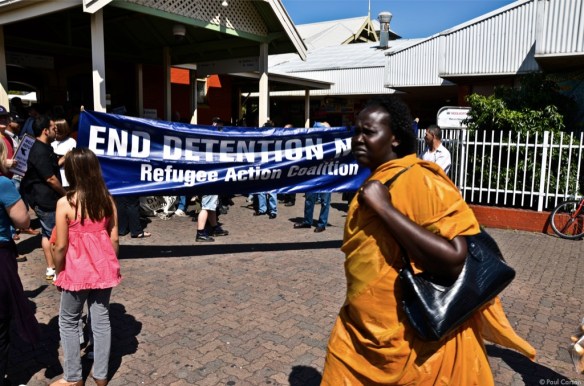
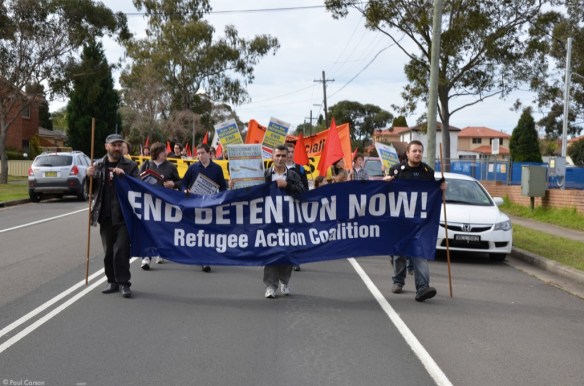
SYDNEY, AUSTRALIA – The Refugee Action Coalition held a rally in support of refugees and asylum seekers outside the Villawood Immigration Detention Centre in Sydney today.

Protesters carry a banner through the screets surrounding the Villawood Immigration Detention Centre.Protesters outside the Villawood Immigration Detention Centre.Protesters outside the Villawood Immigration Detention Centre.Protesters outside the Villawood Immigration Detention Centre.Protesters outside the Villawood Immigration Detention Centre.Protesters and police outside the Villawood Immigration Detention Centre.

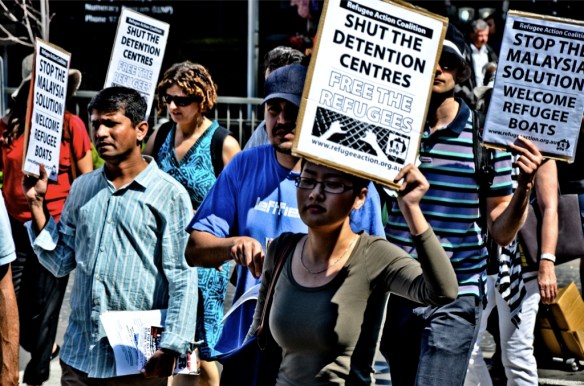
Protesters spoke out against the Gillard government’s “Malaysian solution” in which Australia will “swap” 800 refugees for 4000 asylum seekers already processed in Malaysia.

The crowd also voiced its opposition to the government’s policy of mandatory detention for refugees while their claims are assessed, a process which can take years.

Australian Minister for Immigration Chris Bowen is expected to announce details of the deal with Malaysia tomorrow.

Gaza Flotilla Support Rally

SYDNEY, AUSTRALIA – A small but supportive group met near Sydney’s Town Hall to show solidarity and support for the humanitarian aid flotilla bound for Palestine but currently detained in various ports in Greece by local authorities.

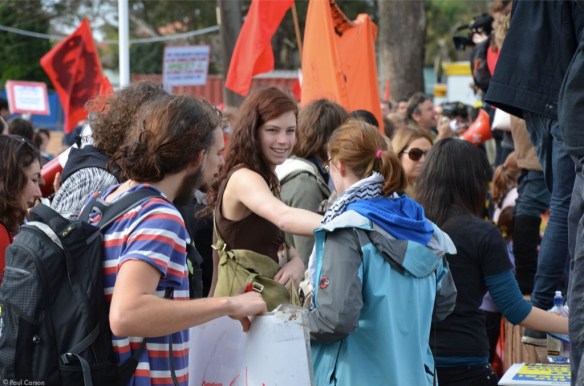
Pro-Palestine rally organisers setting up for a gathering outside Town Hall in downtown Sydney.

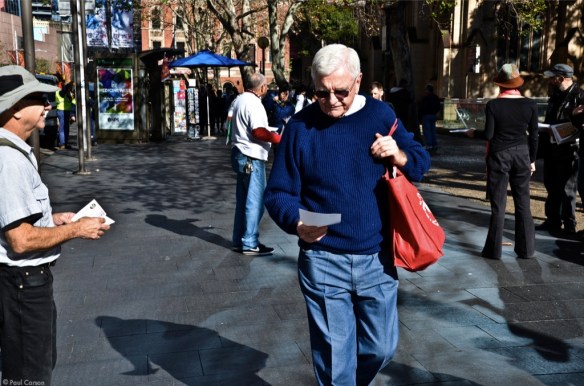
A passerby takes a leaflet from a pro-Gaza protester.

A rally organiser liases with police.

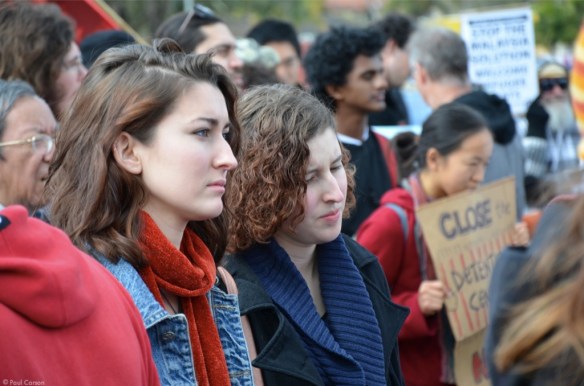
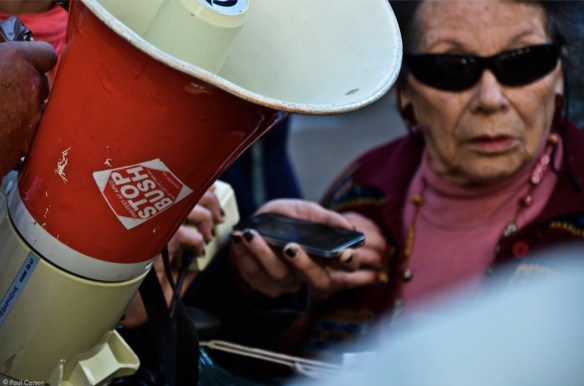
Supporters listen to speakers at a pro-Gaza rally.

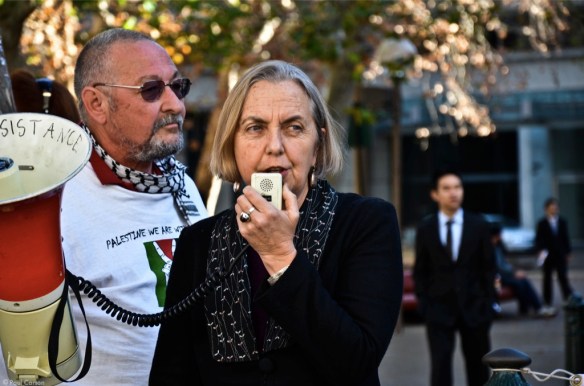
NSW Greens senator Lee Rhiannon addresses the crowd.

Supporters listen to speakers at a pro-Gaza rally.

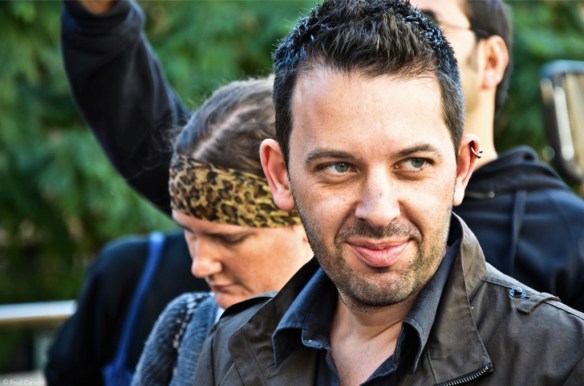
Blogger and freelance journalist Antony Loewenstein at the pro-Gaza rally.

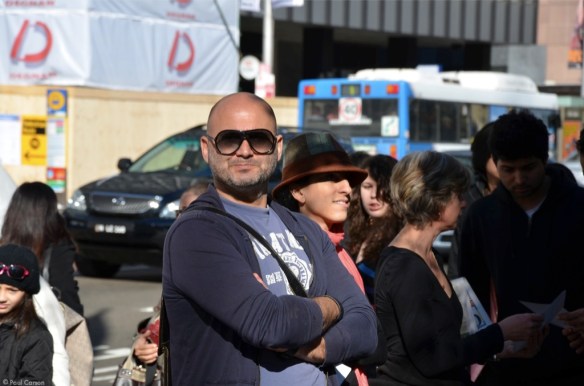
Supporters listen to speakers at a pro-Gaza rally.

Supporters listen to speakers at a pro-Gaza rally.

The group gathered to hear from NSW Greens senator Lee Rhiannon as well as writer and activist Antony Loewenstein. Vivienne Porzsolt and Sylvia Hale are with the flotilla as Australian Freedom Flotilla delegates, and addressed the group by telephone.

Deadly Legacy Of A Secret War

PHONSAVAN, LAOS – Not many people would’ve heard of this town. And surprisingly few would know that this province in central Laos holds the tragic distinction of being the most heavily bombed part of the world, per capita, in history. This small mountainous area holds many secrets that the United States was actively involved in, and the results of those secrets remain buried today, and still continue to kill.

A path marker placed by the Mines Advisory group. These are used to make a path along an area that has been “demined”, or cleared of UXO.

In the mid-1960s until 1975, the United States ran a secret war in Laos, overseen by the CIA and fought by “sheep-dipped” military personnel who flew their combat missions out of uniform. The ground troops (and even a fair portion of the air force) were made up of local Hmong tribespeople. The enemy was the Pathet Lao, a revolutionary Communist military force backed by Ho Chi Minh and the North Vietnamese Army. This action was part of Ho Chi Minh’s dream to create a fully Communist Indochina comprising of Vietnam, Laos, and Cambodia.

The North Vietnamese ran a supply line down into South Vietnam, the famous Ho Chi Minh Trail. It was the existence of this trail that the US used to justify the saturation bombing ofthe areas of Laos and Cambodia (two countries that had nothing to do with the conflict) that bordered Vietnam. Once the NVA began pushing west into Laos, the United States stepped up it’s presence to defend the country against Communism.

Officially, there were no US combat personnel stationed in Laos. The reality was quite different. Operating out of an airfield in the town of Long Tieng, the CIA and the United States Air Force guided fighters and bombers stationed in Thailand in strike missions against Vietnamese supply vehicles on the Ho Chi Minh Trail in southern Laos. They also targetted NVA and Pathet Lao forces engaged in combat against the Lao Royal Army from near Phonsavan to the Vietnamese border.

As the Pathet Lao and the NVA began taking more ground, the USAF began dropping more explosives. Many of these bombs were not very accurate, often straying miles from target and landing on civilian villages. Some of these weapons were cluster bombs, designed to spread it’s lethal payload over a very wide area.

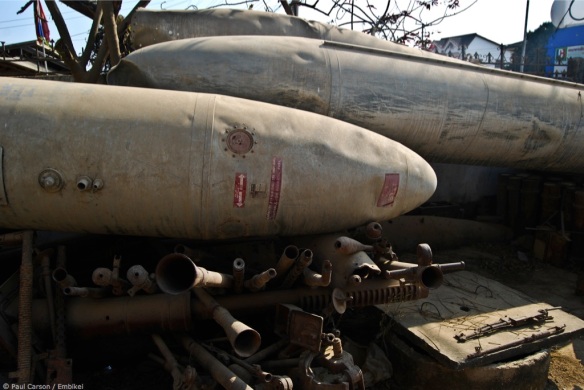
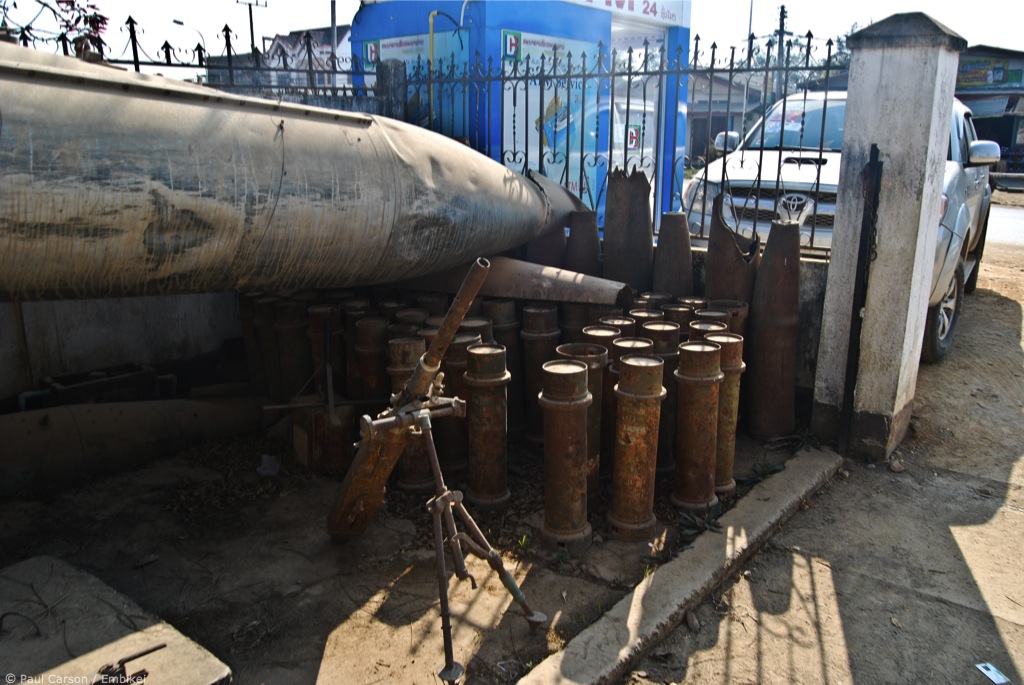
Empty bomb casings on display at the Phonsavan Tourist Information Centre

After nine years of bombing, at least 1.3 million tons of ordnance was dropped on Laos. Around a third of these bombs failed to detonate on impact.

Unfortunately, the deadly legacy continues even now. Many farmers and villagers have been killed by either stumbling across these unstable devices or trying to remove them once they’d been discovered. Because a lot of UXO is buried, some farmers are very reluctant to cultivate their own land for fear of being killed.

The Mines Advisory Group, a UK-based NGO with branches throughout the world, set up a presence in Phonsavan in 1994 and has been working wth local people ever since to make their land safe again. Working with UXO Lao, MAG has been training local people in all aspects of mine and UXO clearance. Given the amount of unexploded ordnance still lying around Laos, and Xieng Khoung province in particuar, this mission will probably take a long time to complete.

Uncertainly at Waterlogged Lakeside

PHNOM PENH, CAMBODIA – Flooding is a problem which characterises the Cambodian capital. During the wet season, the short but powerful downpours dump more rain on Phnom Penh than the rubbish-clogged drains can handle, and the streets become shallow rivers for a few hours after the rain. Jokes are made of the surf conditions on Street 63.

However, the residents in the city’s Daun Penh district, in which Beoung Kak lake sits, have been copping it worse than many in recent years

On February 6 2007 the government leased the lake for 99 years to Shukaku, Inc., a holding company headed by Cambodian People’s Party senator Lao Meng Kinh. The lake has been leased to the company for 99 years at a price of US$0.60¢ per square meter, or a total value of US$79 million, per year.

Shortly after the signing, the company began dredging the nearby Tonle Sap river and using the sand to fill the lake in. The lake acted as a natural reservoir for the city during the monsoon season and did much to prevent flooding in the area.

Since well over 70% of the lake no longer exists, and is awaiting the construction of luxury apartments and shopping centres on the reclaimed soil, this reservoir no longer exists, and so residents and businesses along the edge of the lake are now flooding out.

I took these photos on August 23 2010, and when I awoke this morning I saw that the waters are rising even moreso due to last night’s rain. This has been going on for four days now. At least one house in the neighbouhood became so waterlogged that it collapsed. Two guesthouses are completely empty, prospective tenants understandably reluctant to wade through shin-deep mucky water to reach their rooms.

The story around the Lakeside district is the same; construction will start in a year, and landowners will be given US$8000 as compensation and forced to move, often up to 20 kilometers away. Thousands of families along the lake’s (former) south and west shore have already been moved on.

Most people face an uncertain future, with plans for their eventual fate taking on the air of rumour. Some think the Lakeside district along Street 93 will remain unchanged, some are expecting the bulldozers to come in as soon as the high-rise condos go up. Many have nowhere else to go, having build their homes and businesses and lives in the area.

The project has been controversial from day one, with complaints ranging from the view being spoiled to entire communes collapsing into the rising waters. There have been recent rumours of the foreign investment companies that had initially signed on for the development getting cold feet due to the Global Financial Crisis and putting their plans on-hold indefinitely.

Regardless of whether the construction goes ahead or not, the damage has been done. The backpackers have lost their beautiful sunset view, thousands of families have lost their homes, and Phnom Penh has lost a part of it’s history.


All Aboard The Battambang Bamboo Express

BATTAMBANG, CAMBODIA – With the upgrade of the rail line which runs between Battambang and Phnom Penh, a testament to Cambodian ingenuity will soon come to an end.

The bamboo train, a homebrew rail service that provides transport between many of the villages around Battambang, is scheduled to be stopped next month.

The villagers took it upon themselves to get around the problem of transporting goods and people by taking over the disused rail track running through the villages. A group of people began building their own platforms made of bamboo and wood, attaching wheels from old tanks, and running them along the track.

Previously, these bamboo platforms were powered by someone using a pole to push it along the track. These days, locomotion is provided by a small 5 horsepower motor connected to the rear set of wheels by a fan belt.

The bamboo train (each vehicle known locally as a “norry”) moves not-so-smoothly along the dilapidated track at up to 40 km/h. Locals use the norrys to transport livestock and grain to market, or to their homes. It’s become quite a tourist attraction, with visitors enjoying the scenic ride as well.

Given the number of norrys travelling on the single line, a system of etiquette has arisen when two norrys travelling in the opposite direction meet.

The norry with a lighter load is picked up off the track o the heavier-laden norry can continue on. The pilot of the more loaded norry helps to take the lighter one off the track and put it back on again.

Despite the stretch of track (which goes all the way to Phnom Penh) being one of few sections of rail to survive the Khmer Rouge regime, it’s in very shoddy shape. Much of the track is warped, and the joins are so rough that running over them can be a boneshaking experience. Until November 2008, there was a proper train service between Phnom Penh and Battambang. However, the track is in such disrepair that the 275 kilometer journey could take up to 14 hours. A slow train indeed. The service has been cancelled, probably because of the disintegration of the track, but also due to the impending repair work that will allow regular trains to run at a more regular speed.

Unfortunately for the villagers around Battambang, such progress will mean and end to their ad hoc transport system. A small norry construction industry has sprung up, and there are numerous small stores along parts of the track that act as rest stops for norry passengers and their drivers.

Oun and his wife Sem run one such stall about 7 kilometers from “norry central”, where most visitors catch the bamboo train. They offer shade and cool refreshments to travellers.

Given the highly unofficial status of the bamboo railway, it’s inevitable in a way that it would one day finish. However, it’s sad to see something this unique (not to mention useful to the local people as well as providing jobs for many) come to an end.

My Photo in the Financial Times

Earlier this month the photographic editor of the Financial Times contacted me and asked if she could use the below shot in a feature about the changing face of Phnom Penh.

Of course, I said yes, and forwarded on an untouched version of the image for their use.

The piece was published both online and in print yesterday.

Bangkok Dangerous

BANGKOK, THAILAND – Attempts to move around central Bangkok are frustrating, what with the main Red Shirt encampment covering a fair part of Rama I Road from near the end of Sukhumvit Road, directly under the Skytrain west of Ploen Chit station.

DSC_5303

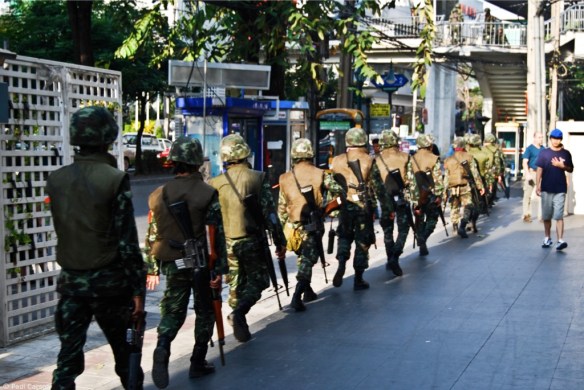
Thai soldiers deployed through the streets of Bangkok.

DSC_5381

The Red Shirt barricade of bamboo and razor wire blocking off Rama I Road at Ploen Chit.

DSC_5392

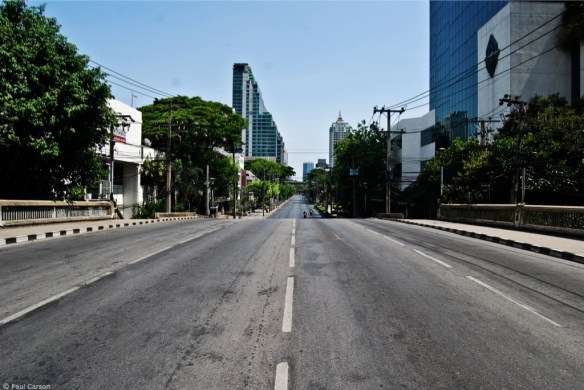
An eerily empty Witthayu Road near central Bangkok

DSC_5449

A monk approaches Red Shirt protesters on Ratchaparop Road

DSC_5452

Red Shirt barricades on Ratchaparop Road

DSC_5467

Rubble litters Ratchaparop Road

DSC_5475

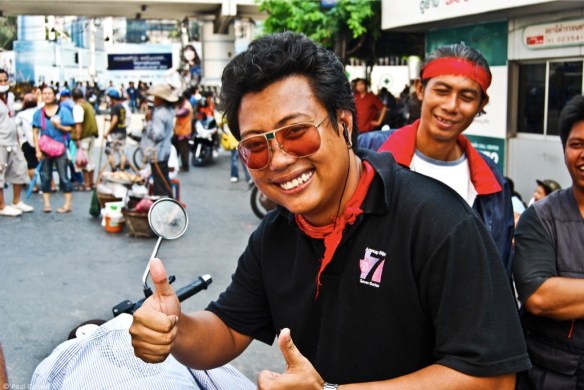
Red Shirt protester

DSC_5511

Life goes on amid the pandemonium

DSC_5513

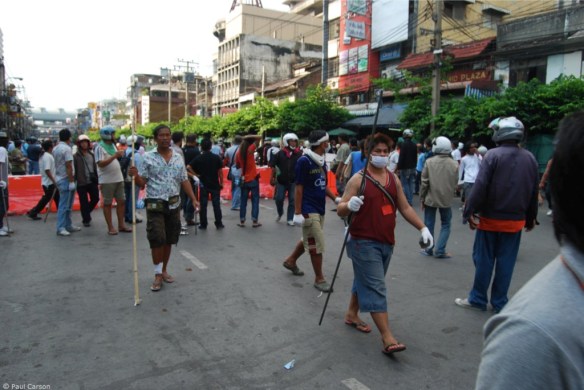
Red Shirt protesters armed with sticks and pieces of concrete move back from the barricade between them and Thai military forces

DSC_5567

Red Shirt protester

DSC_5568

Red Shirt protester

DSC_5569

Red Shirt protester

DSC_5623

The Thai Army heading back to barracks

DSC_5641

Smoke from burning tyres fills the sky above Bangkok

DSC_5690

Smoke from burning tyres fills the sky above Bangkok