Cambodian opposition MP starts election campaign

BATTAMBANG, CAMBODIA – Cambodian opposition party Member of Parliament Mu Sochua commenced her campaign in Battambang in the run-up to the commune elections to be held early next month.

Mu Sochua, Sam Rainsy Party Member of Parliament

Mu Sochua meets the public in Battambang.
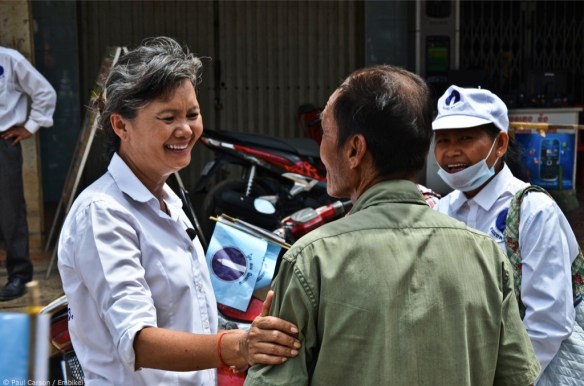
Mu Sochua meets the public in Battambang.
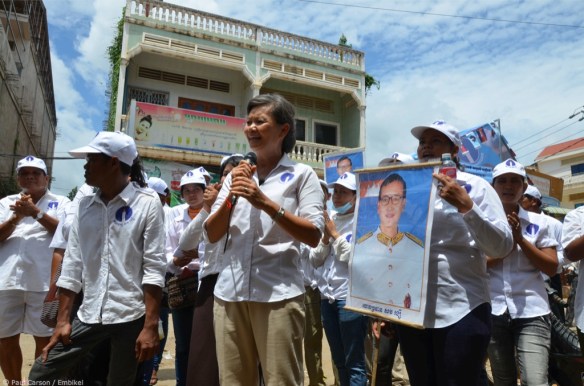
Mu Sochua leading supporters in a song outside a market in Battambang.

Sam Rainsy Party MP Mu Sochua

Supporters of Mu Sochua riding through Battambang.

Mu Sochua in her campaign vehicle on the way to a rally at a temple on the outskirts of Battambang.

Sam Rainsy Party supporters carry the party flag.

The campaign convoy started near Psar Nath, one of Battambang’s main markets, and wound its way through the streets. Mu Sochua stopped a few times at other streetside markets to give speeches and meet with local people before moving to a temple several kilometres from town for a refreshment break.

Supporters wearing white t-shirts and caps printed with the Sam Rainsy Party logo took part in the convoy, riding motor scooters, cars and trucks through the outskirts of Battambang to the temple in Ek Phnom district

After the break, the convoy resumed its trip through the province.

In 1972, when Mu Sochua was 18 years old, she was sent to live in Paris by her mother. The war in Vietnam was spilling over the border into Cambodia, causing many people to flee the country.

Two years after leaving her homeland, Sochua moved to San Francisco to pursue an education at the Berkeley campus of the University of California as well as San Francisco State University.

The Cambodian capital Phnom Penh fell to the control of the Khmer Rouge the following year, 1975.

When the Vietnamese removed the Khmer Rouge from power in early 1979, Cambodian refugees poured out of the region, with many settling in the United States. While studying in California Sochua was doing work with refugees from all over the world, and says that she spent many days at San Francisco Airport in the hope that one day she would she her family step off the plane.

That wish was never granted. Sochua never saw her family again.

After finishing her bachelor’s degree in Psychology and a masters in Social Work, Sochua returned to Cambodia in 1990 to assist in the rebuilding of her country, a task she describes as “paying (her) dues”.

Mu Sochua was a member of Prime Minister Hun Sen’s Cambodian People’s Party until January of 2004 when she left to join the opposition Sam Rainsy Party. While in the Cambodian People’s Party, Mu Sochua was Minister for Womens’ Affairs, a post she held from 1998 until her resignation from the government party.

During that time, she fought extensively for women’s rights in rural Cambodia and battled human trafficking. She is a renowned advocate for human rights, and this is the platform upon which her political campaign is built.

Deadly Legacy Of A Secret War

PHONSAVAN, LAOS – Not many people would’ve heard of this town. And surprisingly few would know that this province in central Laos holds the tragic distinction of being the most heavily bombed part of the world, per capita, in history. This small mountainous area holds many secrets that the United States was actively involved in, and the results of those secrets remain buried today, and still continue to kill.

A path marker placed by the Mines Advisory group. These are used to make a path along an area that has been “demined”, or cleared of UXO.

In the mid-1960s until 1975, the United States ran a secret war in Laos, overseen by the CIA and fought by “sheep-dipped” military personnel who flew their combat missions out of uniform. The ground troops (and even a fair portion of the air force) were made up of local Hmong tribespeople. The enemy was the Pathet Lao, a revolutionary Communist military force backed by Ho Chi Minh and the North Vietnamese Army. This action was part of Ho Chi Minh’s dream to create a fully Communist Indochina comprising of Vietnam, Laos, and Cambodia.

The North Vietnamese ran a supply line down into South Vietnam, the famous Ho Chi Minh Trail. It was the existence of this trail that the US used to justify the saturation bombing ofthe areas of Laos and Cambodia (two countries that had nothing to do with the conflict) that bordered Vietnam. Once the NVA began pushing west into Laos, the United States stepped up it’s presence to defend the country against Communism.

Officially, there were no US combat personnel stationed in Laos. The reality was quite different. Operating out of an airfield in the town of Long Tieng, the CIA and the United States Air Force guided fighters and bombers stationed in Thailand in strike missions against Vietnamese supply vehicles on the Ho Chi Minh Trail in southern Laos. They also targetted NVA and Pathet Lao forces engaged in combat against the Lao Royal Army from near Phonsavan to the Vietnamese border.

As the Pathet Lao and the NVA began taking more ground, the USAF began dropping more explosives. Many of these bombs were not very accurate, often straying miles from target and landing on civilian villages. Some of these weapons were cluster bombs, designed to spread it’s lethal payload over a very wide area.

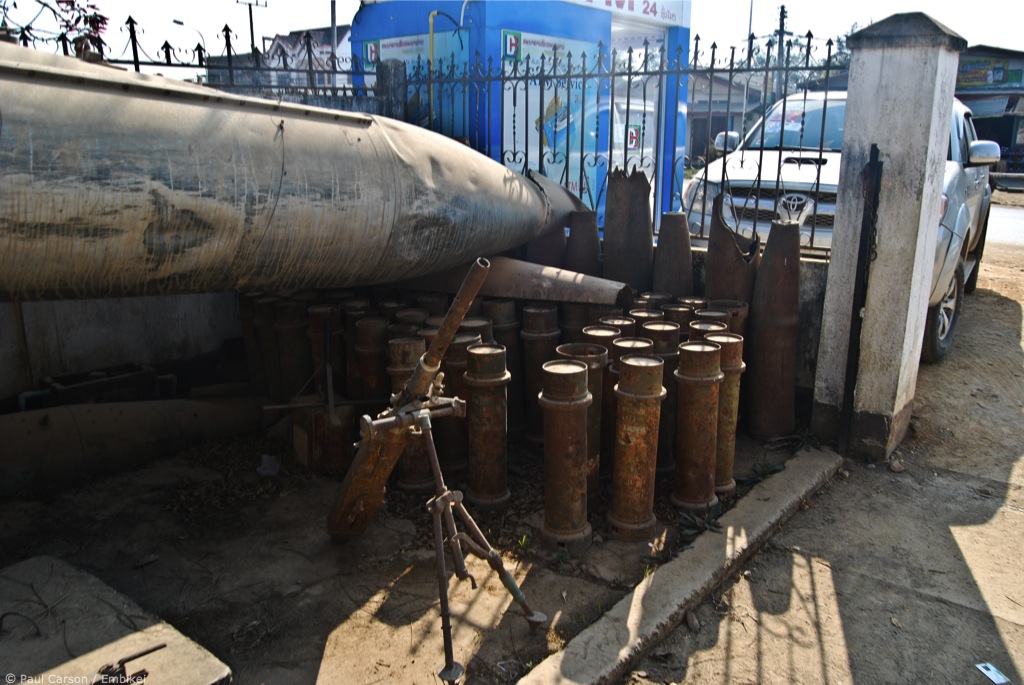
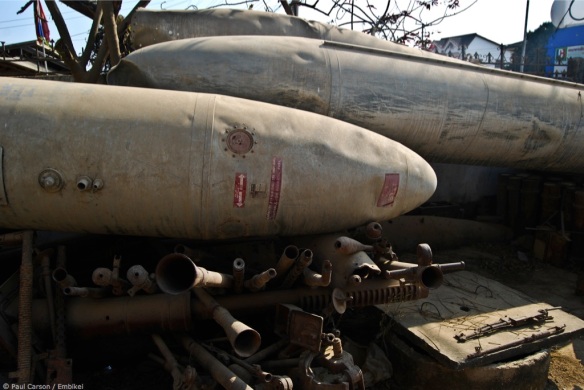
Empty bomb casings on display at the Phonsavan Tourist Information Centre

After nine years of bombing, at least 1.3 million tons of ordnance was dropped on Laos. Around a third of these bombs failed to detonate on impact.

Unfortunately, the deadly legacy continues even now. Many farmers and villagers have been killed by either stumbling across these unstable devices or trying to remove them once they’d been discovered. Because a lot of UXO is buried, some farmers are very reluctant to cultivate their own land for fear of being killed.

The Mines Advisory Group, a UK-based NGO with branches throughout the world, set up a presence in Phonsavan in 1994 and has been working wth local people ever since to make their land safe again. Working with UXO Lao, MAG has been training local people in all aspects of mine and UXO clearance. Given the amount of unexploded ordnance still lying around Laos, and Xieng Khoung province in particuar, this mission will probably take a long time to complete.

Relaxing In The Northeast

KRATIE, CAMBODIA – for the first time in a long time, I’ve travelled to a town that is not familiar to me. This has resulted in the traveller feeling surrounding me once more. It’s a sensation I didn’t even realise I missed.

As much as I love all the places I’ve been to in Cambodia, it’s refreshing to arrive in a new town without knowing too much about it.

My bus ride from Siem Reap to Kampong Cham was not a lot of fun due to a massive overindulgence of Crown Beer the night before (self-inflicted, no sympathy for the devil, etc., but to refuse the hospitality of Sophol and his friends would’ve been impolite) and a very crowded share taxi from Kampong Cham. Nine people in a Camry does not make for a comfortable trip. Fortunately, it didn’t take as long as I thought it would.

Duly ensconced in a guesthouse across from the market, I fuelled up on one of the tastiest full English breakfasts I’d ever had (even though it was about four in the arvo), had a quick shower and then strolled about town with my camera.

Kratie sits on the eastern bank of the Mekong River. I figured that I’d be able to get some good sunset shots over the water.

This is a lovely peaceful town, very low-key, with a few foreigners. But Siem Reap it definitely ain’t. This was illustrated by the fact that I’ve been able to go for a walk around town twice and not once was I asked for a tuktuk/moto ride. I can see myself spending quite a bit of time here, but alas, it will have to be later. The clock is ticking and I have to reluctantly be moving on.

City Of Ghosts

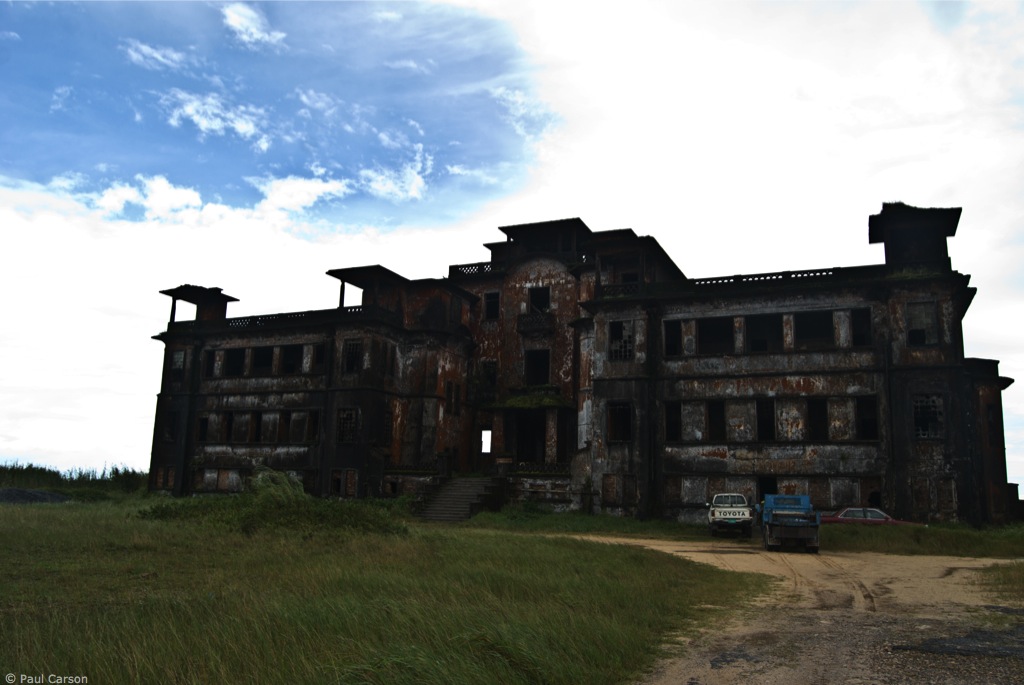
Built in the early 20th century for the rich French elite, the village atop Phnom Bokor once contained a casino hotel, nightclubs, and villas. It fell into disuse just after Cambodia’s independence from France in 1954, and King Sihanouk attempted to revitalise the town soon afterwards. The town was abandoned again in the early 1970s when the Khmer Rouge were fighting to overrun the Lon Nol government.

From 1976 until 1978, the Khmer Rouge used the old casino as a prison, and the commander of the district lived in the old Catholic church. The site has been occupied only by park rangers since 1978.

The entire hill was recently purchased by a large conglomerate, and they have plans to build a 12-storey 5-star monstrosity just down the road from where the remnants of the French colonial buildings stand.

Fortunately (and surprisingly), the old buildings will be preserved.

More photos of the amazing and eerie Bokor Hill Station can be seen on my Flickr page.

Uncertainly at Waterlogged Lakeside

PHNOM PENH, CAMBODIA – Flooding is a problem which characterises the Cambodian capital. During the wet season, the short but powerful downpours dump more rain on Phnom Penh than the rubbish-clogged drains can handle, and the streets become shallow rivers for a few hours after the rain. Jokes are made of the surf conditions on Street 63.

However, the residents in the city’s Daun Penh district, in which Beoung Kak lake sits, have been copping it worse than many in recent years

On February 6 2007 the government leased the lake for 99 years to Shukaku, Inc., a holding company headed by Cambodian People’s Party senator Lao Meng Kinh. The lake has been leased to the company for 99 years at a price of US$0.60¢ per square meter, or a total value of US$79 million, per year.

Shortly after the signing, the company began dredging the nearby Tonle Sap river and using the sand to fill the lake in. The lake acted as a natural reservoir for the city during the monsoon season and did much to prevent flooding in the area.

Since well over 70% of the lake no longer exists, and is awaiting the construction of luxury apartments and shopping centres on the reclaimed soil, this reservoir no longer exists, and so residents and businesses along the edge of the lake are now flooding out.

I took these photos on August 23 2010, and when I awoke this morning I saw that the waters are rising even moreso due to last night’s rain. This has been going on for four days now. At least one house in the neighbouhood became so waterlogged that it collapsed. Two guesthouses are completely empty, prospective tenants understandably reluctant to wade through shin-deep mucky water to reach their rooms.

The story around the Lakeside district is the same; construction will start in a year, and landowners will be given US$8000 as compensation and forced to move, often up to 20 kilometers away. Thousands of families along the lake’s (former) south and west shore have already been moved on.

Most people face an uncertain future, with plans for their eventual fate taking on the air of rumour. Some think the Lakeside district along Street 93 will remain unchanged, some are expecting the bulldozers to come in as soon as the high-rise condos go up. Many have nowhere else to go, having build their homes and businesses and lives in the area.

The project has been controversial from day one, with complaints ranging from the view being spoiled to entire communes collapsing into the rising waters. There have been recent rumours of the foreign investment companies that had initially signed on for the development getting cold feet due to the Global Financial Crisis and putting their plans on-hold indefinitely.

Regardless of whether the construction goes ahead or not, the damage has been done. The backpackers have lost their beautiful sunset view, thousands of families have lost their homes, and Phnom Penh has lost a part of it’s history.


All Aboard The Battambang Bamboo Express

BATTAMBANG, CAMBODIA – With the upgrade of the rail line which runs between Battambang and Phnom Penh, a testament to Cambodian ingenuity will soon come to an end.

The bamboo train, a homebrew rail service that provides transport between many of the villages around Battambang, is scheduled to be stopped next month.

The villagers took it upon themselves to get around the problem of transporting goods and people by taking over the disused rail track running through the villages. A group of people began building their own platforms made of bamboo and wood, attaching wheels from old tanks, and running them along the track.

Previously, these bamboo platforms were powered by someone using a pole to push it along the track. These days, locomotion is provided by a small 5 horsepower motor connected to the rear set of wheels by a fan belt.

The bamboo train (each vehicle known locally as a “norry”) moves not-so-smoothly along the dilapidated track at up to 40 km/h. Locals use the norrys to transport livestock and grain to market, or to their homes. It’s become quite a tourist attraction, with visitors enjoying the scenic ride as well.

Given the number of norrys travelling on the single line, a system of etiquette has arisen when two norrys travelling in the opposite direction meet.

The norry with a lighter load is picked up off the track o the heavier-laden norry can continue on. The pilot of the more loaded norry helps to take the lighter one off the track and put it back on again.

Despite the stretch of track (which goes all the way to Phnom Penh) being one of few sections of rail to survive the Khmer Rouge regime, it’s in very shoddy shape. Much of the track is warped, and the joins are so rough that running over them can be a boneshaking experience. Until November 2008, there was a proper train service between Phnom Penh and Battambang. However, the track is in such disrepair that the 275 kilometer journey could take up to 14 hours. A slow train indeed. The service has been cancelled, probably because of the disintegration of the track, but also due to the impending repair work that will allow regular trains to run at a more regular speed.

Unfortunately for the villagers around Battambang, such progress will mean and end to their ad hoc transport system. A small norry construction industry has sprung up, and there are numerous small stores along parts of the track that act as rest stops for norry passengers and their drivers.

Oun and his wife Sem run one such stall about 7 kilometers from “norry central”, where most visitors catch the bamboo train. They offer shade and cool refreshments to travellers.

Given the highly unofficial status of the bamboo railway, it’s inevitable in a way that it would one day finish. However, it’s sad to see something this unique (not to mention useful to the local people as well as providing jobs for many) come to an end.