
Battambang, Cambodia – A Buddhist monk takes video of a rally in support of the Cambodian National Rescue Party ahead of the country’s national election this Sunday.

Battambang, Cambodia – A Buddhist monk takes video of a rally in support of the Cambodian National Rescue Party ahead of the country’s national election this Sunday.
It’s good to be back.

ANLONG VENG, CAMBODIA – Grey clouds hung heavy in the dim sky, and a light rain fell. The sun was a milky disc and the air was noticeably cooler than what’s generally found in the rest of Cambodia.
A perfect day to inspect the final resting place of the former leader of a genocidal regime that slaughtered millions in under four years.
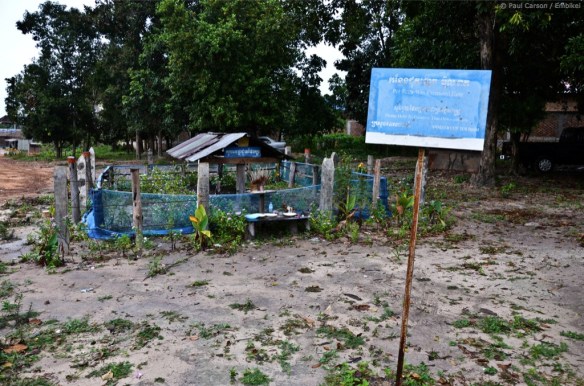
The site where former Khmer Rouge leader Pol Pot was cremated.
Sunshine and twittering birds would feel out of order when viewing the final resting place of a man who had a major hand in the death of millions of his fellow Cambodians. Also vastly inappropriate would be some towering monument to his purity of vision, the glory of a revolution that was meant to make Cambodia a self-sufficient agrarian paradise, a vision that soon gave way to total insanity, the systematic slaughter of a nation, and the near-total destruction of a culture that has spanned over a thousand years.
Pol Pot died in mid-April of 1998 (nobody knows the exact date, though April 15 is widely cited) in Chong Sa Ngam village north of Anlong Veng, about a kilometer from the Thai border. Equally speculative is the cause of death. A heart attack, old age, pneumonia, suicide, poisoning by disgruntled ex-Khmer Rouge forces, even assassination by a Thai hit squad are some of the possible causes that have been aired since that day. Like many things in Cambodia, the truth is obscured by speculation, wishful thinking, and myth,
Immediately after his death, Pol Pot’s body was photographed in situ and promptly taken outside and cremated. His furniture and some of the material from his house were used as fuel for the pyre. Photographs of the event make it seem more like he was burned along with a pile of rubbish that was lying around.
Again, some would see that as fitting.
More impressive, if that’s the word, is the grave of Ta Mok (named Chhit Choeun at birth), the commander of the Khmer Rouge’s military.

Ta Mok’s grave
After the Vietnamese removed the Khmer Rouge from power in 1979, Ta Mok fled to northern Cambodia with Pol Pot and continued to direct missions against the Vietnamese and, later, the Cambodian government lead by Hun Sen.
Eventually captured by the government in March 1999, Ta Mok was taken to Phnom Penh and placed in custody awaiting trial for his crimes. He eventually died without facing trial on 21 July 2006.
Prior to his arrest, Ta Mok spent his time at a house in the Dângrêk Mountains north of Anlong Veng.

Grafitti inside Ta Mok’s mountain retreat
He also maintained a villa on the outskirts of Anlong Veng.


Interior of Ta Mok’s house in Anlong Veng
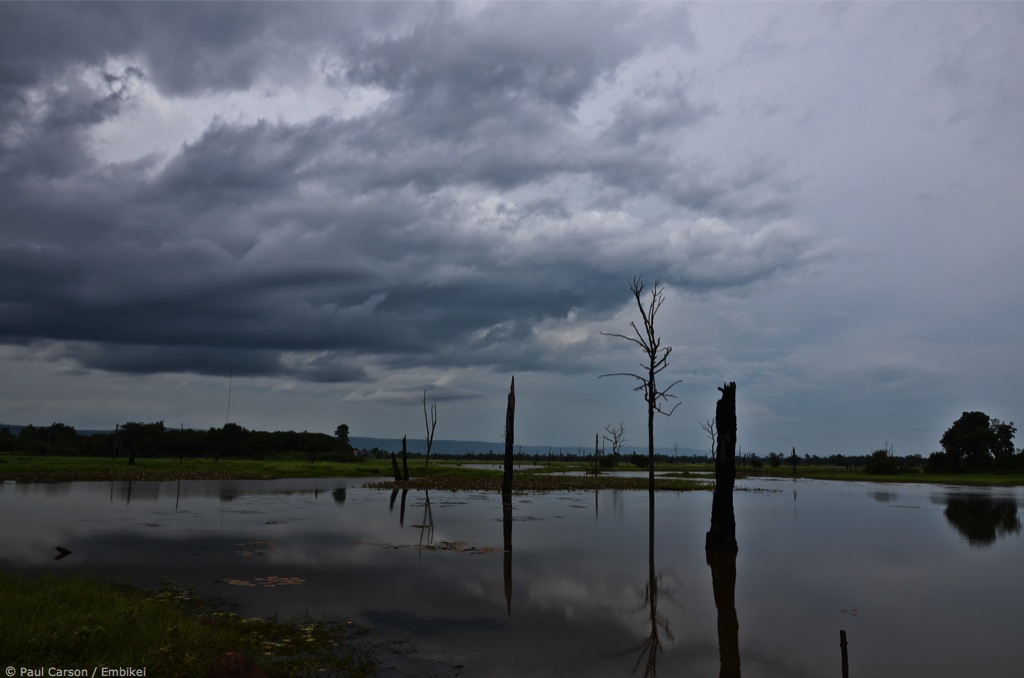
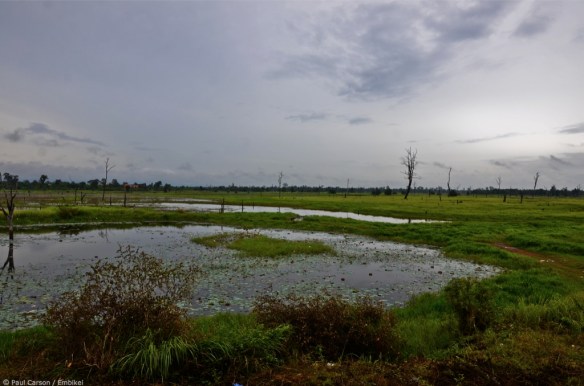
A lake as seen from Ta Mok’s house. The lake formed as a result of dam construction on the edge of town. The dam was commissioned by Ta Mok during the Khmer Rouge years.
The town has a dark history, with Khmer Rouge elements being very active here as recently as 1998. But that terrible past runs in direct contrast to the spectacular beauty of the natural scenery. Deep green jungle covers tall mountains that are cloaked in mist during the rainy season.

Anlong Veng, because of its location and its recent history, has been isolated from the rest of Cambodia until recently. Many towns are given the “Wild West” tag in this country, but Anlong Veng deserves it more than most of the others. Despite being connected to Siem Reap by a decent road, it may continue to be relatively isolated for a while yet.
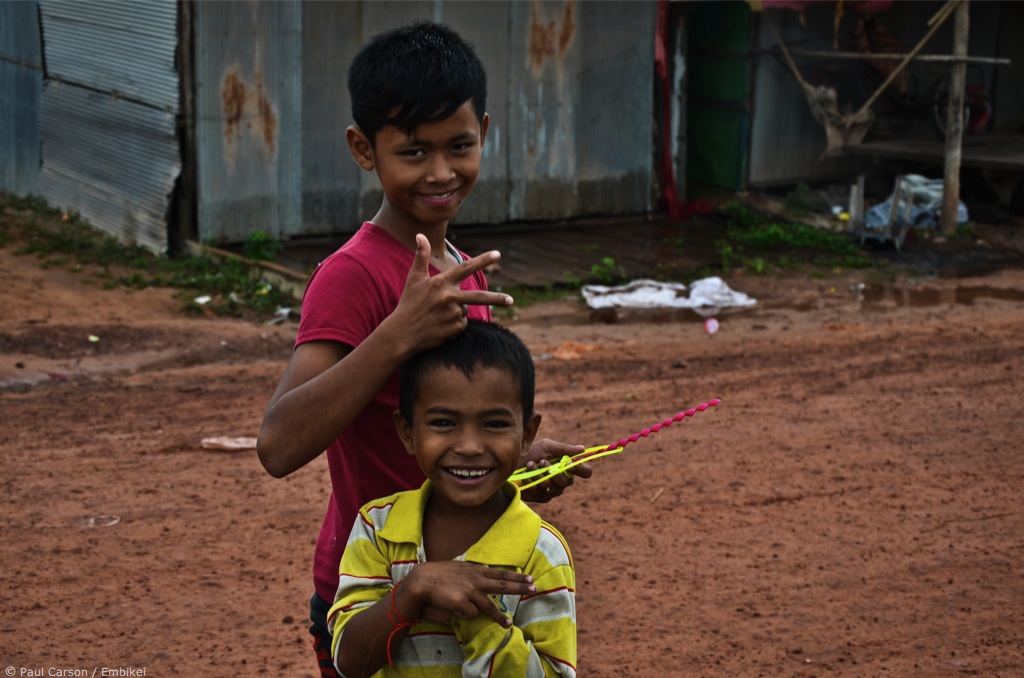
As I said when I went on my first walk around Kampong Cham yesterday, “Another day, another new favourite Cambodian town.”

Kampong Cham is Cambodia’s third-largest town and lies beside the Mekong River.
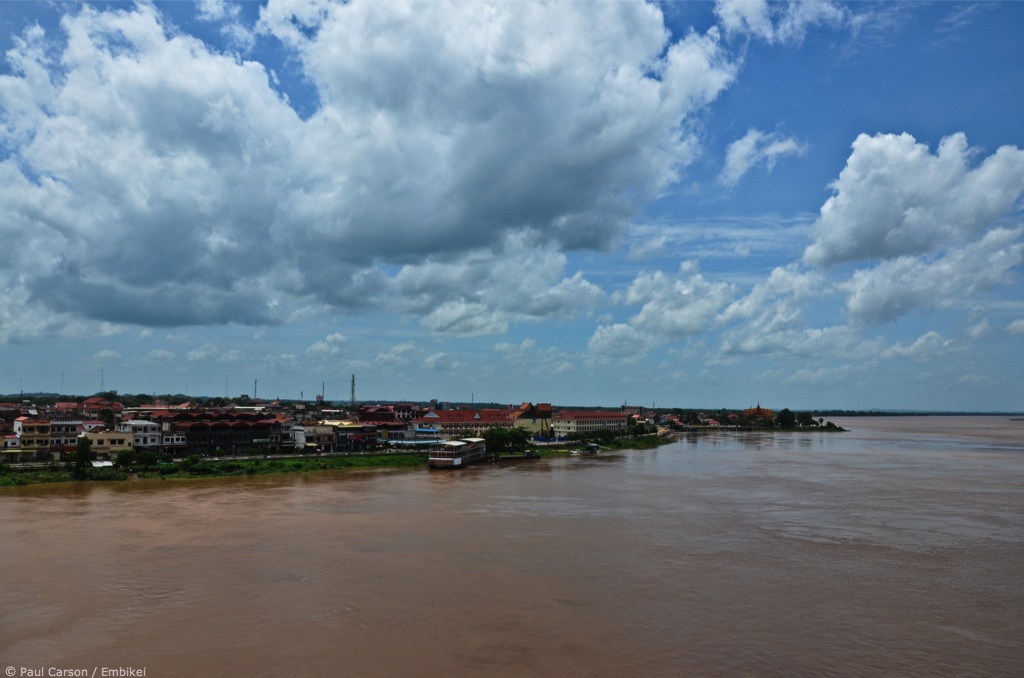


The town still manages to maintain a certain rural charm.

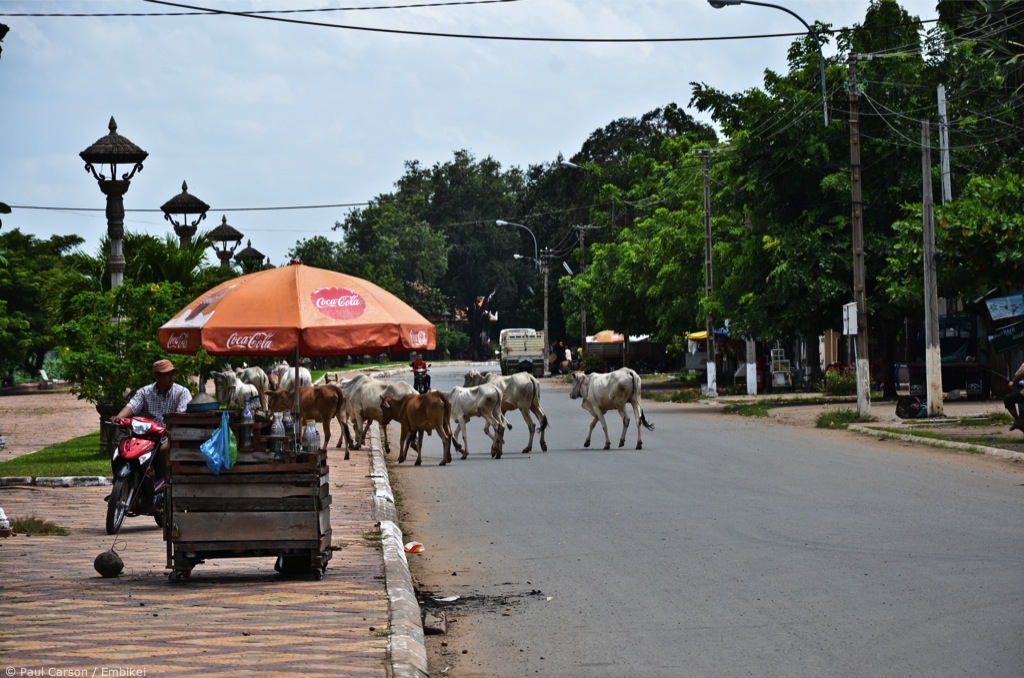
Many of the French Colonial buildings seem to have been kept with some integrity, lacking the more modern adornments (eg. huge billboards) that seem to be bolted on in other towns. Although some of the buildings could do with some attention.


SEN MONOROM, CAMBODIA – 800 meters above sea level, in Mondulkiri province, it’s noticeably less warm and humid than the more inhabited and visited lowlands of Cambodia. The air is fresh, and refreshingly crisp.
However, a dose of the flu and some very unpredictable weather has meant that I’ve not been able to get into the jungle or take as many photos as I would’ve liked. But I’ve been enjoying the relaxed vibe of Sen Monorom, the provincial capitol. And it’s nice to not be perspiring all the time.



After having not been there for about 18 months, I decided to check out what’s left of the Boeung Kak district of Phnom Penh, the area formerly known as Lakeside.

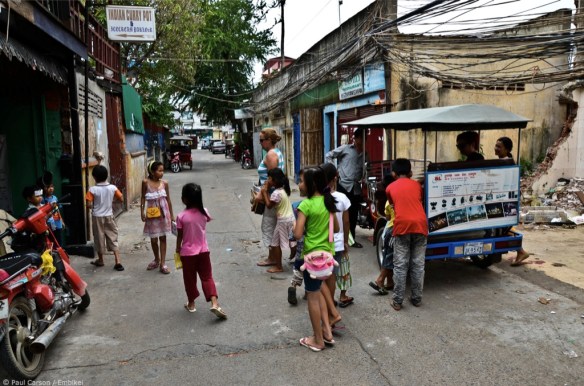

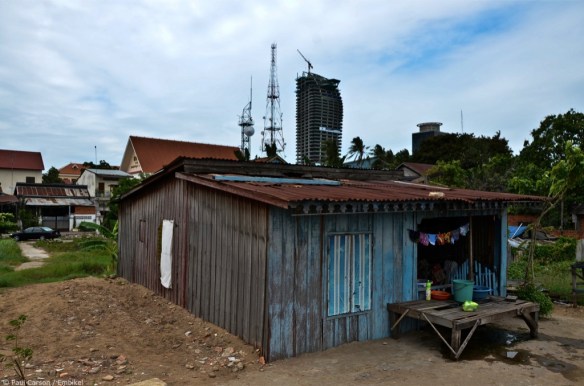


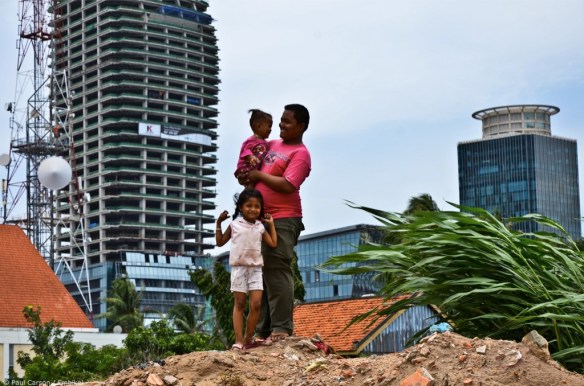


In August of 2010 I wrote a piece about the development of Boeung Kak by Shukaku, Inc. While construction has not yet commenced, most of the businesses around the now filled-in lake have either closed down or moved, but there are a few holdouts against the decline of the neighbourhood. Grand View and Number 10 are two of the old guesthouses still operating (though the view is far from grand now), and the only actual bar still there is Lost And Found.
I spoke with a tuktuk driver who’d lived in the area for most of his life, and he was of the opinion that once the proposed highrise buildings went up, bulldozers would be run through the rest of that end of Street 93 to make way for an access road to the development.
But, as many people like to say, “This is Cambodia.” Anything could happen at any time, or nothing might happen for years.
A small town 17 kilometers from the Thai border and 80 kilometers from Battambang, Pailin is often called the Wild West of Cambodia. During my three-night stay, I didn’t see another Westerner. I was even forced to try out my very limited Khmer when it came to ordering food and drinks and finding out how much things cost. Pailin would be the perfect antidote to anyone burned out from Cambodia’s “tourist trail”.

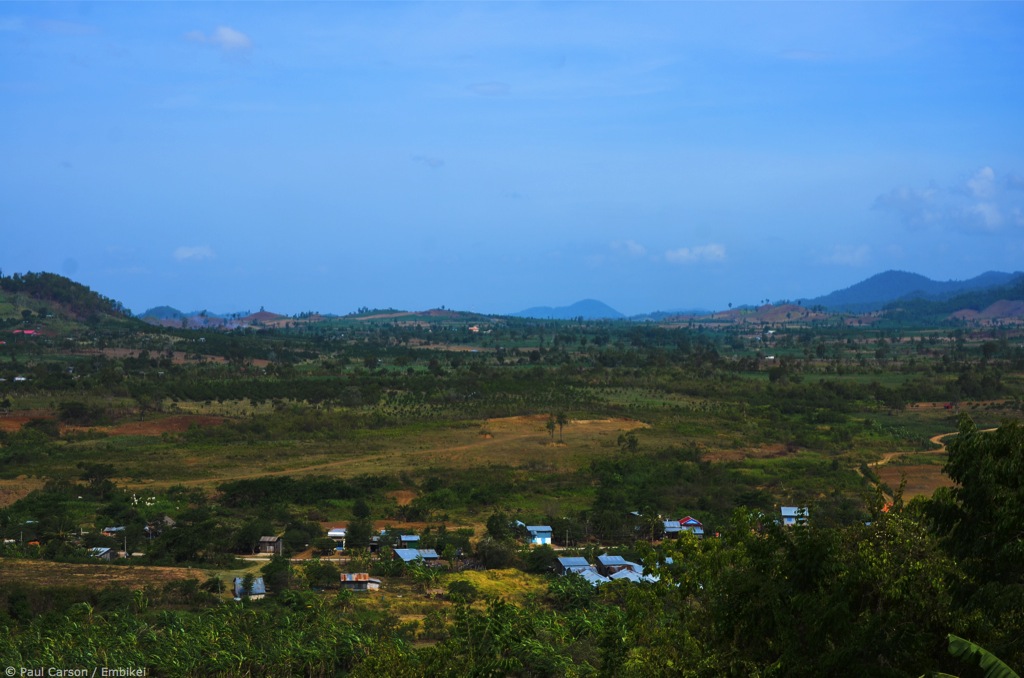
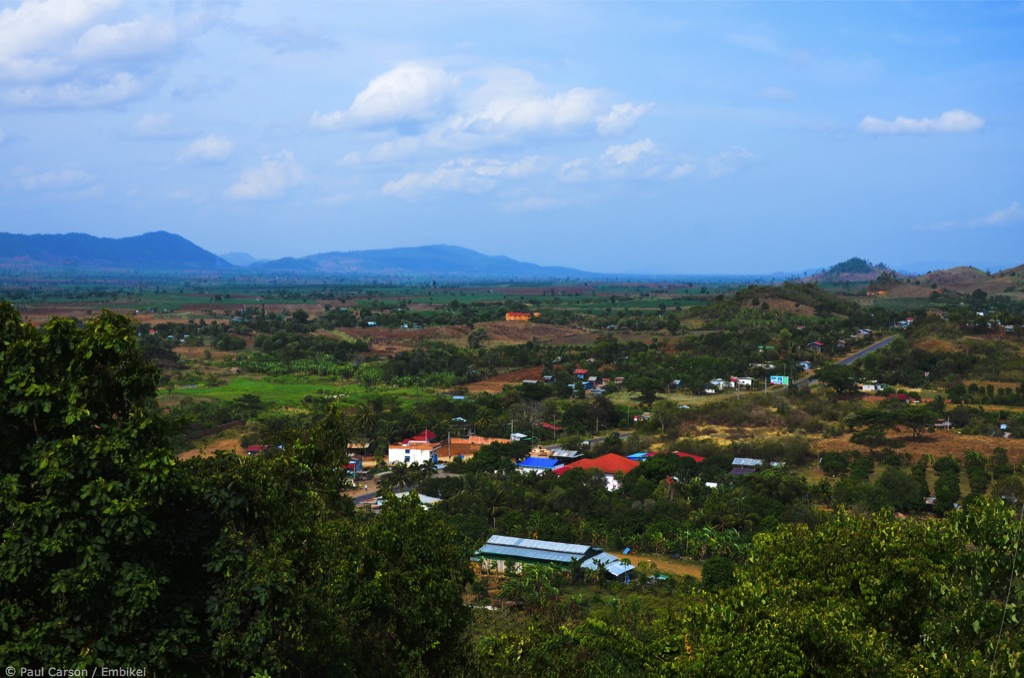
It’s true that there’s not a lot here for travellers, but for me that’s part of its appeal. There are no Western-style bars, no nightlife to speak of. It’s a true Cambodian town which has not felt the touch of tourism. In fact, every transport option that I was given while there offered me a lift out of town, either to Battambang or to the Thai border. For a Westerner to stay in Pailin is evidently still something of a novelty.
The town has a chequered past, from being a wealthy area famous for its abundance of gems and timber in the 1800s to being one of the last strongholds of the Khmer Rouge as recently as 1998.
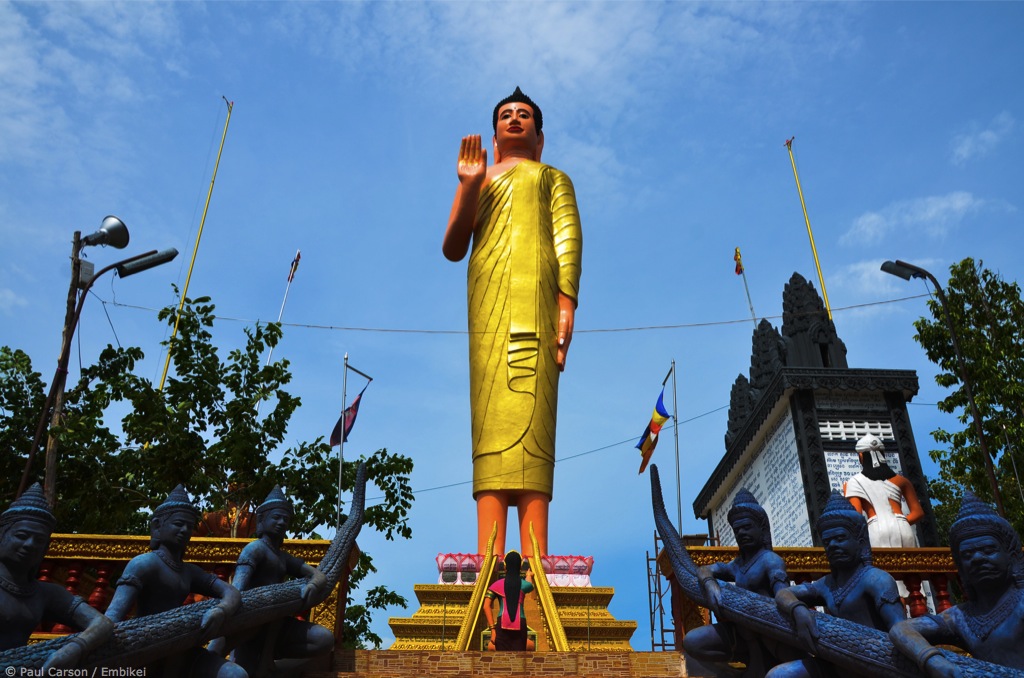
The area is populated with descendents of Burmese immigrants who came to the area in the late 1800s in search of fortune. One of the remaining influences from Burma is the golden stupa at Wat Phnom Yat on the edge of town.

Tiny Planets, an iOS app developed by Infoding, creates some very interesting photo effects…

Independence Monument / Phnom Penh, Cambodia

San Francisco City Hall

Angkor Wat / near Siem Reap, Cambodia

Huntington Beach, USA

Royal Palace / Phnom Penh, Cambodia

Golden Gate Bridge / San Francisco, USA
BATTAMBANG, CAMBODIA – Cambodian opposition party Member of Parliament Mu Sochua commenced her campaign in Battambang in the run-up to the commune elections to be held early next month.
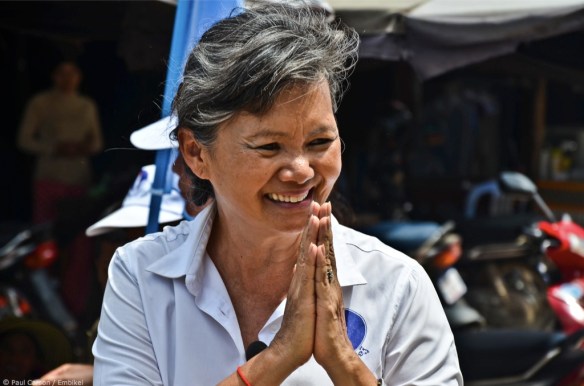
Mu Sochua, Sam Rainsy Party Member of Parliament
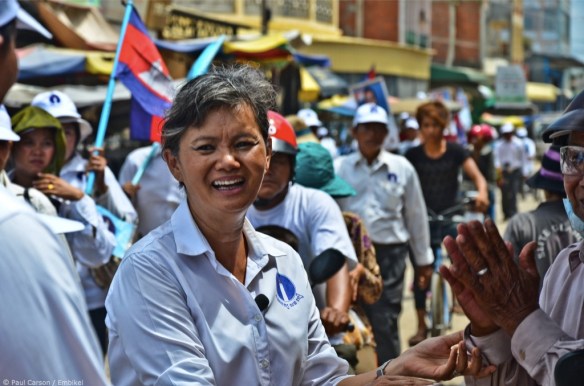
Mu Sochua meets the public in Battambang.
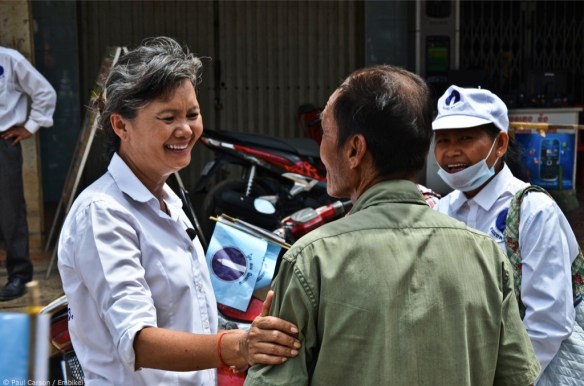
Mu Sochua meets the public in Battambang.
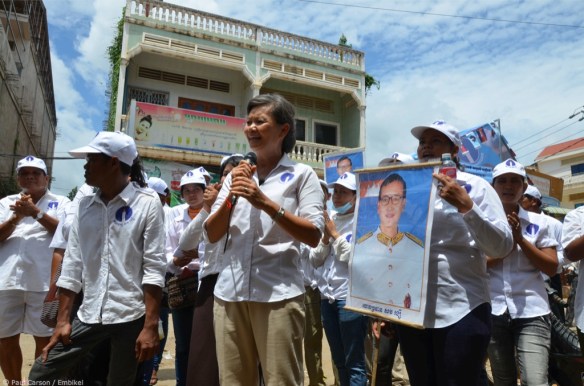
Mu Sochua leading supporters in a song outside a market in Battambang.
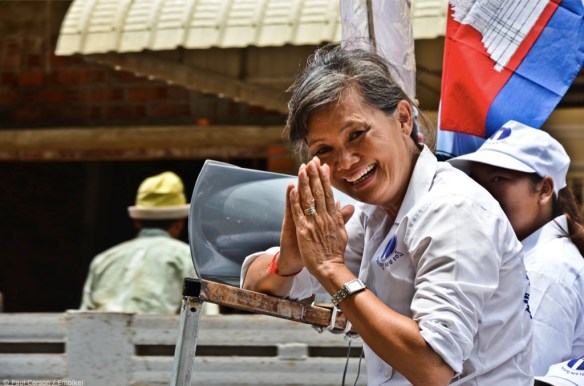
Sam Rainsy Party MP Mu Sochua

Supporters of Mu Sochua riding through Battambang.

Mu Sochua in her campaign vehicle on the way to a rally at a temple on the outskirts of Battambang.

Sam Rainsy Party supporters carry the party flag.
The campaign convoy started near Psar Nath, one of Battambang’s main markets, and wound its way through the streets. Mu Sochua stopped a few times at other streetside markets to give speeches and meet with local people before moving to a temple several kilometres from town for a refreshment break.
Supporters wearing white t-shirts and caps printed with the Sam Rainsy Party logo took part in the convoy, riding motor scooters, cars and trucks through the outskirts of Battambang to the temple in Ek Phnom district
After the break, the convoy resumed its trip through the province.
In 1972, when Mu Sochua was 18 years old, she was sent to live in Paris by her mother. The war in Vietnam was spilling over the border into Cambodia, causing many people to flee the country.
Two years after leaving her homeland, Sochua moved to San Francisco to pursue an education at the Berkeley campus of the University of California as well as San Francisco State University.
The Cambodian capital Phnom Penh fell to the control of the Khmer Rouge the following year, 1975.
When the Vietnamese removed the Khmer Rouge from power in early 1979, Cambodian refugees poured out of the region, with many settling in the United States. While studying in California Sochua was doing work with refugees from all over the world, and says that she spent many days at San Francisco Airport in the hope that one day she would she her family step off the plane.
That wish was never granted. Sochua never saw her family again.
After finishing her bachelor’s degree in Psychology and a masters in Social Work, Sochua returned to Cambodia in 1990 to assist in the rebuilding of her country, a task she describes as “paying (her) dues”.
Mu Sochua was a member of Prime Minister Hun Sen’s Cambodian People’s Party until January of 2004 when she left to join the opposition Sam Rainsy Party. While in the Cambodian People’s Party, Mu Sochua was Minister for Womens’ Affairs, a post she held from 1998 until her resignation from the government party.
During that time, she fought extensively for women’s rights in rural Cambodia and battled human trafficking. She is a renowned advocate for human rights, and this is the platform upon which her political campaign is built.
PHONSAVAN, LAOS – Not many people would’ve heard of this town. And surprisingly few would know that this province in central Laos holds the tragic distinction of being the most heavily bombed part of the world, per capita, in history. This small mountainous area holds many secrets that the United States was actively involved in, and the results of those secrets remain buried today, and still continue to kill.

A path marker placed by the Mines Advisory group. These are used to make a path along an area that has been “demined”, or cleared of UXO.
In the mid-1960s until 1975, the United States ran a secret war in Laos, overseen by the CIA and fought by “sheep-dipped” military personnel who flew their combat missions out of uniform. The ground troops (and even a fair portion of the air force) were made up of local Hmong tribespeople. The enemy was the Pathet Lao, a revolutionary Communist military force backed by Ho Chi Minh and the North Vietnamese Army. This action was part of Ho Chi Minh’s dream to create a fully Communist Indochina comprising of Vietnam, Laos, and Cambodia.
The North Vietnamese ran a supply line down into South Vietnam, the famous Ho Chi Minh Trail. It was the existence of this trail that the US used to justify the saturation bombing ofthe areas of Laos and Cambodia (two countries that had nothing to do with the conflict) that bordered Vietnam. Once the NVA began pushing west into Laos, the United States stepped up it’s presence to defend the country against Communism.
Officially, there were no US combat personnel stationed in Laos. The reality was quite different. Operating out of an airfield in the town of Long Tieng, the CIA and the United States Air Force guided fighters and bombers stationed in Thailand in strike missions against Vietnamese supply vehicles on the Ho Chi Minh Trail in southern Laos. They also targetted NVA and Pathet Lao forces engaged in combat against the Lao Royal Army from near Phonsavan to the Vietnamese border.
As the Pathet Lao and the NVA began taking more ground, the USAF began dropping more explosives. Many of these bombs were not very accurate, often straying miles from target and landing on civilian villages. Some of these weapons were cluster bombs, designed to spread it’s lethal payload over a very wide area.
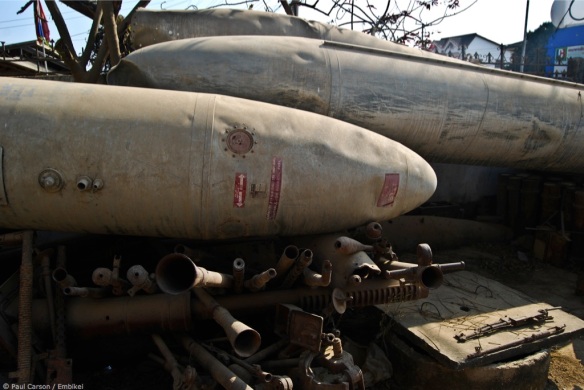
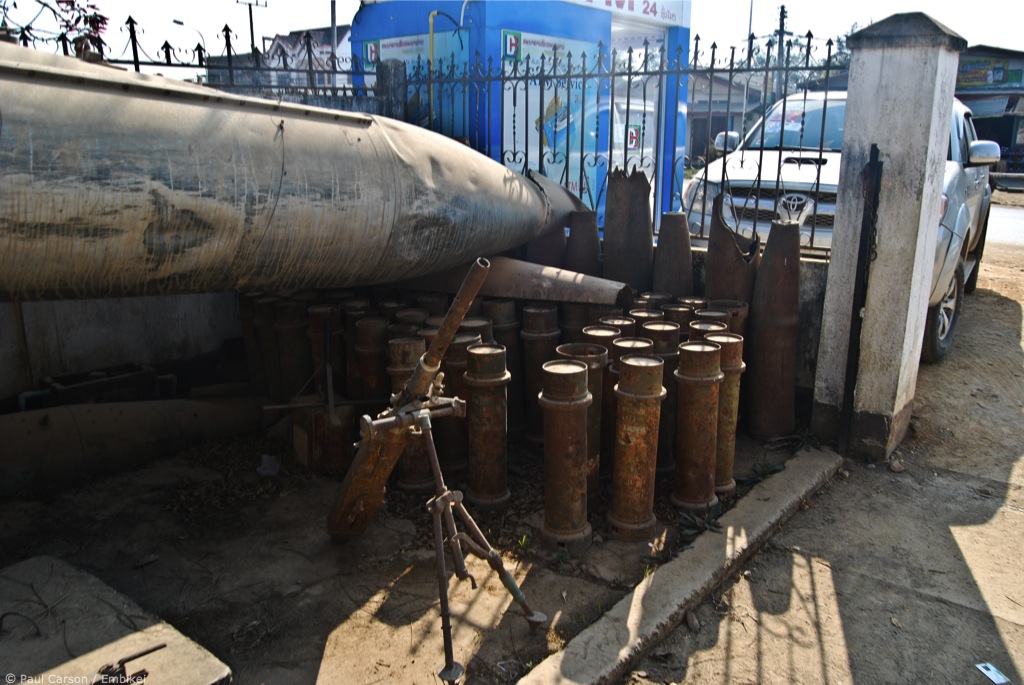
Empty bomb casings on display at the Phonsavan Tourist Information Centre
After nine years of bombing, at least 1.3 million tons of ordnance was dropped on Laos. Around a third of these bombs failed to detonate on impact.
Unfortunately, the deadly legacy continues even now. Many farmers and villagers have been killed by either stumbling across these unstable devices or trying to remove them once they’d been discovered. Because a lot of UXO is buried, some farmers are very reluctant to cultivate their own land for fear of being killed.
The Mines Advisory Group, a UK-based NGO with branches throughout the world, set up a presence in Phonsavan in 1994 and has been working wth local people ever since to make their land safe again. Working with UXO Lao, MAG has been training local people in all aspects of mine and UXO clearance. Given the amount of unexploded ordnance still lying around Laos, and Xieng Khoung province in particuar, this mission will probably take a long time to complete.
 Embikei